The first week in Antananarivo is almost complete. I worked three days in the office – Wednesday through Friday – and am starting to gain a broad understanding of my responsibilities. The local staff have given me a quite the acceuil chaleurux (warm welcome) and I look forward to working with them over the next eight months. I found my French to be a little rusty on the first day, but I am already noticing improvement and I am gaining new vocabulary every day, as all of my conversations are in French. I have long wanted a total immersion experience in the French language, and I finally have the chance to do that, in Madagascar of all places.
My first impressions of Tana came with a taxi ride at midnight from the airport to my hotel. We sped along a curved highway that wound through what appeared to be lakes on either side. But when I asked the driver about it, he said they were in fact rice paddies. “We eat rice three times a day,” he told me in French, emphasizing the importance of this staple in the Malagasy diet. The reflection of the full moon on the water added a surrealist element to our journey.
By day, Tana looks much like other cities I’ve visited in Africa (Bujumbura, Burundi and Bamako, Mali). The streets are invariably lined with refuse and the infrastructure has a very run-down appearance. Little shops made of brick and corrugated metal roofs dominate the city outside of downtown. Auto repair garages, electronics vendors, clothiers, eateries, and other establishments are sandwiched side by side. There is a frenetic energy about all of it as people everywhere are hustling for their livelihood, pushing wheelbarrows full of assorted goods, clutching chickens to their chests, and haggling with customers in the merchant stalls. Taxi drivers wait with anticipation at seemingly every corner, eager to flag down a customer, particularly a foreigner. The taxis honked every time they passed me, hoping that I would make eye contact. I finally did take a taxi from downtown back to my apartment in mid-afternoon; I felt like I was in a bumper car, with the vehicle’s tiny interior and non-functional seatbelt. While I didn’t feel particularly safe, I did enjoy the chance to do some drive-by photography of the bustling streets.
Amidst the obvious squalor, Tana has pockets of wealth, most noticeably in the retail outlets that sell luxury, imported goods. These places have polished interiors, chic advertising, and an obvious security presence. It is clear that expats and the upper-crust of Malagasy society are the only customer base in mind. They seem bizarrely out of place, as if someone had lifted a piece of Paris or New York and dropped it in Tana. Away from the choked and dirty streets, and the throngs of ordinary Malagasies, the expats socialize in their preferred restaurants and cafes, as I discovered today when I stumbled upon a resto called the Hotel des Artistes for lunch. I enjoyed a meal of confit de canard and passed a couple of hours people-watching and scribbling three new poems in my notebook, inspired by my observations of the day.
And the people? The Malagasies are extremely diverse in appearance, running the gamut from Southeast Asian to black African. Some have skin as light as mine, while others are as dark as anyone I’ve seen in Burundi or Mali. Some Malagasies could be mistaken for Filipino or Indonesian; these are the Merina people, an Austronesian ethnic group that are the descendants of the first colonizers of the island, around 500 AD. The initial Austronesian migration was eventually joined by a second migration from East Africa. The two people groups – Austronesian and African – have intermingled over the centuries, leading to the various ethnic groups that make up the current population. The Merina are known as the people from the haut plateux – the highlands – and have traditionally held a position of privilege in Malagasy society. I have noticed, based on my own observations, that the poorest of the poor – those begging for money on the street – are not the Merina, but rather those of clear East African origin. 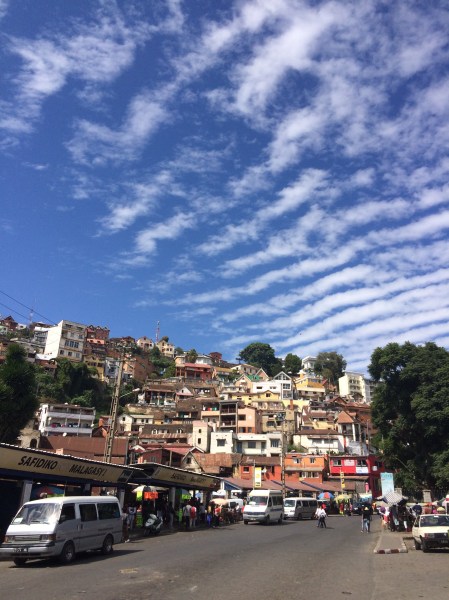
Earlier today I made my first trip to Analakely market. It’s a sprawling complex of permanent merchant stalls selling clothes, jewelry, kitchen ware, and various other goods, kind of like a flea market of sorts, along with a meat market and tables overflowing with fruits, vegetables, spices, peanuts, and dried beans. I came with the intent of buying fresh produce, and walked away with an enormous bag of fruits and vegetables for the equivalent of less than $10: tomatoes, potatoes, lemons, green beans, carrots, avocados, shallots, garlic, and bananas. This would have cost at least three times as much at my local supermarket in the US. As the only foreigner in the place, some of the vendors were quite aggressive in trying to sell their various goods. They know that my pockets are virtually bottomless in such a place, with prices so low. Vanilla, in particular, seems to be an item prized by foreigners, as numerous people approached me around town trying to sell me little packages of vanilla beans. While I didn’t buy any vanilla, I was happy to buy produce from multiple vendors to spread the wealth somewhat.
Downtown Tana seems to be built in a valley, at least in the Analakely area, with steep rising hillsides on both sides. I ascended the stairs on one side and found myself in what I think is the haute ville, with picturesque mansions and a cathedral that are the legacy of the French colonial era.
Overall, there is much more to see in the city and I’ve only scratched the surface so far. I look forward to passing some more time in the cafes on the weekends, soaking in the atmosphere and rediscovering my love of writing.

